1. Caspian Sea - Asia - 371,000 sq km (143,000 sq mi)


The Caspian Sea is the largest enclosed inland body of water
on Earth by area, variously classed as the world's largest lake or a
full-fledged sea. The sea has a surface area of 371,000 km2 (143,200
sq mi) and a volume of 78,200 km3 (18,800 cu mi). It is in an
endorsee basin (it has no outflows) and is bounded to the northwest by Russia,
to the west by Azerbaijan, to the south by Iran, to the southeast by
Turkmenistan, and to the northeast by Kazakhstan.
2. Lake Superior - North America - 82,100 sq km (31,698 sq mi)


Lake Superior is the largest of
the Great Lakes of North America. The lake is bounded by Ontario and Minnesota
to the north and west, and Wisconsin and Michigan to the south. It is generally
considered the largest freshwater lake in the world by surface area. It is the
world's third-largest freshwater lake by volume and the largest by volume in
North America.
3. Lake Victoria - Africa - 68,800 sq km (26,563 sq mi)


Lake Victoria is one of the
African Great Lakes. The lake was named after Queen Victoria, by John Hanning
Speke, an officer in the British Indian Army.
With a surface area of 68,800
square kilometers (26,600 sq mi), Lake Victoria is Africa’s largest lake by
area, and it is the largest tropical lake in the world. Lake Victoria is the
world's 3rd largest freshwater lake by surface area; only Lake Superior in
North America is larger. In terms of its volume, Lake Victoria is the world's
ninth largest continental lake, and it contains about 2,750 cubic kilometers
(2.2 billion acre-feet) of water.
4. Lake Huron - North America - 59,600 sq km (23,011 sq mi)


Lake Huron is one of the five
Great Lakes of North America. Hydrologically, it comprises the easterly portion
of Lake Michigan–Huron, having the same surface elevation as its westerly
counterpart, to which it is connected by the wide Straits of Mackinac. It is
bounded on the east by the Canadian province of Ontario and on the west by the
state of Michigan in the United States. The name of the lake is derived from
early French explorers who named it for the Huron people inhabiting the region.
The huronian glaciation was named due to evidence collected from Lake Huron
region.
5. Lake Michigan - North America - 57,800 sq km (22,316 sq mi)


Lake Michigan is one of the five
Great Lakes of North America and the only one located entirely within the
United States. The other four Great Lakes are shared by the U.S. and Canada. It
is the second largest of the Great Lakes by volume and the third largest by
surface area, after Lake Superior and Lake Huron (and is slightly smaller than
the U.S. state of West Virginia). To the east, its basin is conjoined with that
of Lake Huron through the wide Straits of Mackinac, giving it the same surface
elevation as its easterly counterpart; the two are technically a single
lake. Lake Michigan is bounded, from west to east, by the U.S. states of
Wisconsin, Illinois, Indiana, and Michigan. The word "Michigan"
originally referred to the lake itself, and is believed to come from the Ojibwa
word mishigami meaning "great water".
6. Lake Tanganyika - Africa - 32,900 sq km (12,702 sq mi)


Lake Tanganyika is an African
Great Lake. It is estimated to be the second largest freshwater lake in the
world by volume, and the second deepest, in both cases, after only Lake Baikal
in Siberia; it is also the world's longest freshwater lake. The lake is divided
among four countries – Tanzania, the Democratic Republic of the Congo, Burundi,
and Zambia, with Tanzania (46%) and the DRC (40%) possessing the majority of
the lake. The water flows into the Congo River system and ultimately into the
Atlantic Ocean.
7. Great Bear Lake - North America - 31,328 sq km (12,095 sq mi)


Great Bear Lake is the largest
lake entirely in Canada (Lake Superior and Lake Huron straddling the Canada-US
border are larger), the fourth largest in North America, and the eighth largest
in the world. The lake is in the Northwest Territories, on the Arctic Circle
between 65 and 67 degrees of northern latitude and between 118 and 123 degrees
western longitude, 186 m (610 ft) above sea level. The name originated with the
First Nations living on the northern shores, who called themselves Chipewyan,
meaning “grizzly bear water people.” Grizzly Bear Mountain on the shore of the
Lake comes from the Chipewyan, meaning, “bear large hill.”
8. Baikal - Asia - 30,500 sq km (11,776 sq mi)


Lake Baikal is a rift lake in the south of the Russian region of Siberia,
between the Irkutsk Oblast to the northwest and the Buryat Republic to the
southeast. Lake Baikal is the most voluminous freshwater lake in the world,
containing roughly 20% of the world's unfrozen surface fresh water, and at
1,642 m (5,387 ft), and the deepest. It is also among the clearest of all
lakes, and thought to be the world's oldest lake at 25 million years. It is the
8th largest lake in the world.
9. Lake Malawi (Lake Nyasa) - Africa - 30,044 sq km (11,600 sq mi)
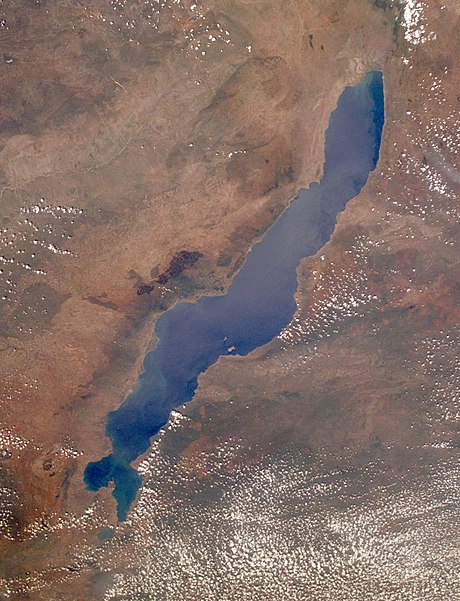

Lake Malawi (Lake Nyasa, or Lago
Niassa in Mozambique), is an African Great Lake and the southernmost lake in
the East African Rift system, located between Malawi, Mozambique and Tanzania.
The third largest and second deepest lake in Africa, it is also the ninth
largest in the world. It is reportedly the habitat of more species of fish than
any other body of freshwater, including more than 1000 species of cichlids, and
was officially declared a reserve by the Government of Mozambique on June 10,
2011.
10. Great Slave Lake - North America - 28,568 sq km (11.030 sq mi)


Great Slave Lake (French: Grand
lac des Esclaves) is the second-largest lake in the Northwest Territories of
Canada (after Great Bear Lake), the deepest lake in North America at 614 metres
(336 fathoms; 2,010 ft), and the ninth-largest lake in the world. It is 480 km
(300 mi) long and 19 to 109 km (12 to 68 mi) wide. It covers an area of 27,200 km2
(10,502 sq mi) in the southern part of the territory. Its given volume ranges
from 1,070 km3 (260 cu mi)[3] to 1,580 km3 (380 cu mi)
and up to 2,088 km3 (501 cu mi) making it the 10th largest.
Source: The Times Atlas of the World